General informationNot legal or engineering advice. This page follows WorkSafe Victoria’s pallet racking guidance, which is written for standard “selective” pallet racking; it says cantilever, drive-in, double-deep, pallet-live, push-back and other specialised racking may need additional measures. Outside Victoria, check with your own regulator, listed by Safe Work Australia.
- No employer, subcontractor or self-employed person should physically alter the uprights, bracing, beams or other components: no welding on extra cleats or bearers, for instance.
- Changing how racking is configured changes its safe working loads, so only the supplier, the supplier’s representative or a suitably competent person should do it.
- The site’s operating instructions should forbid climbing on the racking and any unauthorised alteration.
The load sign
The safe working load (SWL) is the most weight in unit loads a rack can hold and stay safe, and a unit load is one stored item, such as a pallet of goods. WorkSafe Victoria says the SWL should never be exceeded for the unit load, the pallet beam or the bay, and that it is important to measure the weight of each unit load going into the racking. The SWL is available from the manufacturer’s instructions, from AS 4084.2:2023, and from inventory systems that hold the goods’ dimensions and weights.
Employers should tell employees the SWL, for example with signs in visible areas showing:
Safe working load
- Manufacturer, supplier, installation date
- From the manufacturer or designer
- Designer
- From the manufacturer or designer
- Working unit load limit
- Total for each pallet beam level
- Total for each bay
- Base plate to first beam; first to second beam
- From the manufacturer or designer
This drawing shows which fields a sign carries, not any real rack’s figures, which come only from its manufacturer or designer. During an inspection, check that each bay displays the signs the designer provided and that the configuration hasn’t changed.
For uneven loads supported at only two or three points, the guidance says to ask the supplier whether the racking can carry them.
Design, protection and pallets
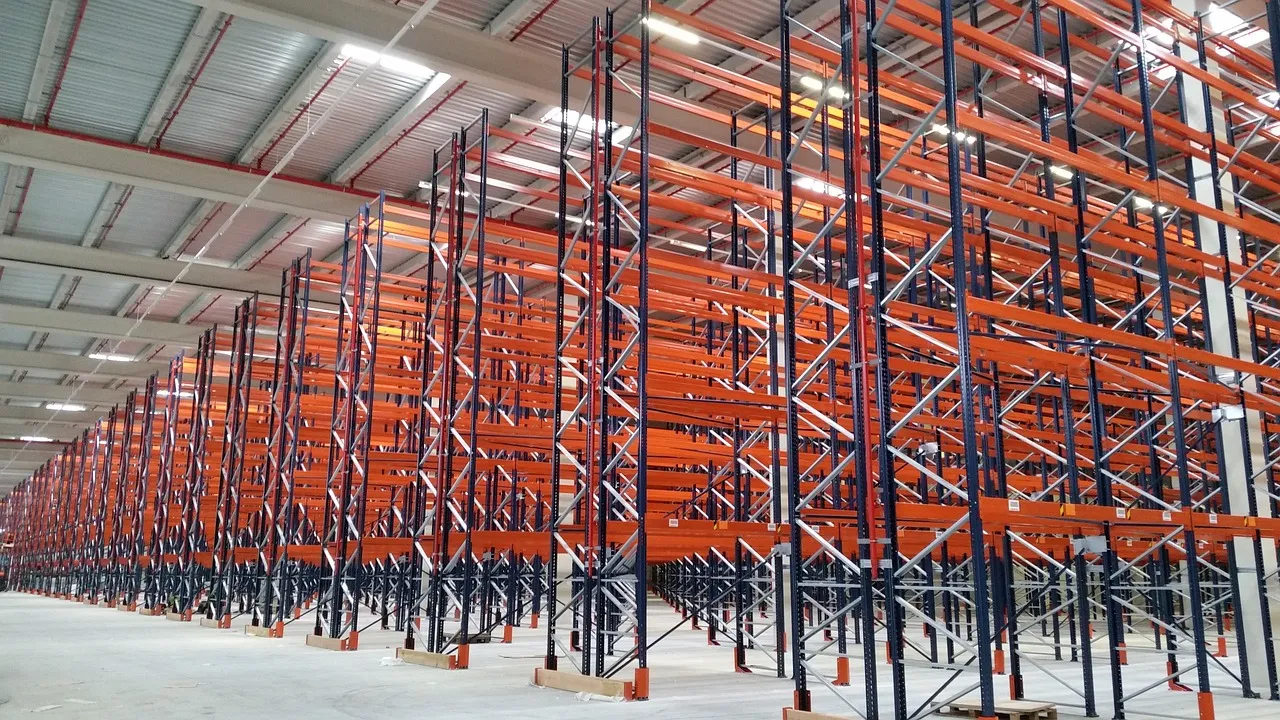
Racking should be designed for the size, shape and weight of what is stored, and to suit the pallets and handling equipment: the aisle width, for example, matched to the turning circle of the forklift used. Any change, such as a different forklift or different products, should be checked by the original supplier, manufacturer or designer.
- Collision protection. Fit upright protectors and end-of-rack protectors, because the lower uprights are exposed to forklifts and other moving equipment.
- Rear protection. Where single-row racking has pedestrians walking behind it, install rear protection so loads can’t fall out of the back.
- Replacement parts. Use only compatible parts supplied by the equipment manufacturer, with changes supervised by a competent person.
Any change to the racking’s design or its parts (a new upright, brace, beam or clip, for example) should, in WorkSafe Victoria’s guidance:
- be overseen by a competent person, including when beams are moved to new heights or positions
- allow for what the change does to the load limits
- come with updated operating procedures, signs and drawings.
Pallets should support the unit load and “key” into the racking so loads can’t be dislodged. The guidance gives four examples of a pallet change that goes wrong:
- post pallets in place of timber put concentrated loads on beams and may not key in
- larger pallets than the design allows can overlap or push others off their supports
- smaller pallets can drop through
- skid pallets without timber decks can drop through.
It also warns that pallets from overseas often come in other sizes that Australian racking may not take, and that a competent person should assess any change to pallet design.
What the operating instructions should cover
WorkSafe Victoria says the instructions should be written for the racking actually on site, and at the least should cover:
- how the equipment is meant to be applied and used
- a ban on unauthorised alterations
- a ban on climbing the racking
- reporting any impact damage so it can be assessed
- inspecting the racking to check it is being used correctly
- keeping to the safe working loads
- keeping the right clearances between the racking and the stored loads
- how goods are secured to the pallet before they go into the racking
- choosing and using the right handling equipment, such as forklifts.
When racking is damaged
Employees should report damage to their employer immediately. The employer assesses it and classifies it into one of three levels, following section 5.5 of AS 4084.2:2023, and management should then advise the health and safety representative. Labelled stick-on tags can show where the damage is and how serious.
Inspections
Informal inspections should happen as often as the manufacturer or a competent person recommends, for example daily or weekly, using simple gauges or measuring tools. A competent person should also complete a formal inspection every 12 months, using an elevating work platform for the upper levels if the racking is more than 8 metres high, and give the employer a report with any corrective actions.
| Part | What to check | What to do |
|---|---|---|
| Unit loads | The right loads for the racking’s design (goods hanging over the pallet edge can be a sign they are not); loads stable and keyed in, with pallets level; loose goods held to the pallet; clearances kept, with nothing touching uprights or beams, over height or over depth. | Wrap or strap loose goods to the pallet. Keep the clearances given in the manufacturer’s instructions. |
| Beams | Large deflection, V-shaped connectors or a permanent bend in an empty beam, which suggest overloading; signs a beam has been hit by a pallet or forklift; safety clips in place; no beam popped out of its upright, which leaves it hanging on one end connector where it could collapse. | If there are signs of overloading, have a competent person or an engineer inspect the racking. Replace damaged beams; where a beam was hit and shows only minor damage, have a competent person check its welds for cracks. Replace missing clips with a design the equipment manufacturer approves, and keep spares on site. If clips keep coming out, ask the manufacturer or installer to find out why, then fix the cause. Never hold beams in place with fixed bolts. |
| Load signs | The designer’s signs displayed; configuration unchanged; loads within the SWL for each beam and the whole bay. | Review the unit loads. The guidance suggests a report from the inventory system could pick out beams or bays at capacity, to audit or to spread the load. |
| Uprights and footplates | Significant damage, twisting, splits or cracks; splices manufacturer-approved, above the first beam level, not below 1.5 m, and no more than one between adjacent beam levels. | Replace a significantly damaged, twisted, split or cracked upright, or splice in a new section with a splice the equipment manufacturer approves. When an upright is damaged, replace its footplate too. |
| Plumb | Racking that isn’t vertical, which may come from installation, impact, overloading or a settling slab. | Contact the manufacturer or installer. |
| Braces | Bent horizontal or diagonal braces; deviation from a 1 m straight edge of more than 10 mm in either plane. | Replace bent braces. |
| Floor fixings | Fixings installed and undamaged, with at least 2 anchors in each footplate. | Replace damaged floor fixings, and the footplate with them. |
Nothing hanging over the aisle
In 2021 WorkSafe Victoria issued a safety alert after a reach forklift operator was fatally injured: the forklift struck items stored at height that overhung the aisle, and they fell on the operator. The alert says stored items should be contained within the racking and secured against collapse, and lists ways to comply, including:
- a system of upright storage where nothing protrudes into the path of powered mobile plant
- a fixed physical barrier that keeps plant and pedestrians from travelling under or close to overhanging items
- a falling object protective structure on forklifts.
When WorkSafe Victoria must be told
Employees should report all racking safety risks to their employer, who must reduce them so far as is reasonably practicable. Some incidents must be reported to WorkSafe straight away. The guidance gives examples: someone needing medical treatment at once, or someone exposed to a serious risk to their health or safety from an immediate or imminent exposure, which WorkSafe says includes a person who would have been exposed even if they were not nearby at the time, because plant, a substance or any other thing fell or was released from height, because plant collapsed, tipped over, failed, malfunctioned or was damaged, or because a building or structure fell down in whole or in part. WorkSafe Victoria’s page on notifiable incidents has the full criteria.